The Welcome Begins Before the Desk
A casino arrival welcome starts before check-in: clear greetings, visible orientation and a calm first exchange help guests understand where to go.
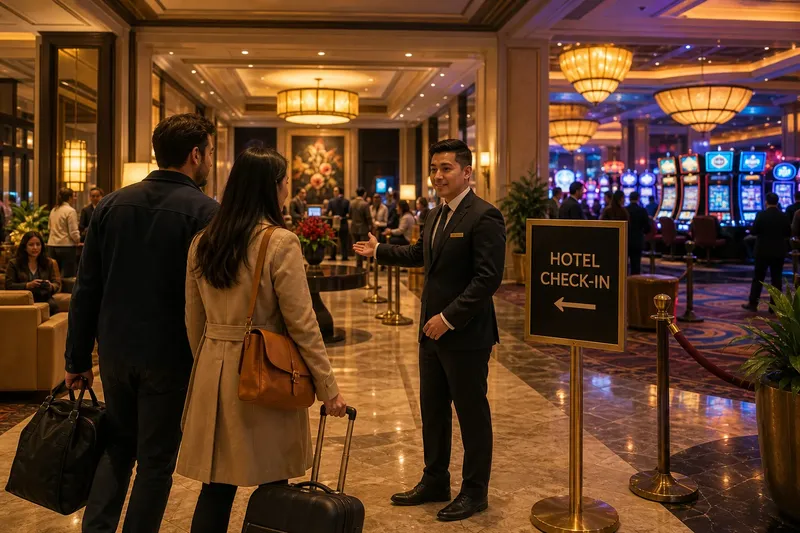
At the entrance, a guest pauses beside a brass stanchion, holding a coat over one arm while the lobby carries the layered sounds of rolling luggage, conversation and a nearby slot floor. A casino arrival welcome begins here, before the desk: with a staff member who notices the pause, a clear greeting and a visible sense of where the guest can go next.
That first moment is not a performance to be polished into a script. It is a practical exchange in a busy hospitality setting, where people may be arriving for a room, a restaurant, a show, a gaming area or simply to meet someone. Small cues help them orient themselves without making them feel hurried or singled out.
What does the guest see before reaching the desk?
Consider a clearly hypothetical situation at a casino resort on a busy evening. A couple, Maya and Leon, enter carrying overnight bags. They have a room reservation, but the lobby is unfamiliar, the check-in line is visible only from one angle, and a bright bank of gaming machines draws attention in the opposite direction.
Near the entrance, a host stands where arriving guests can see them without having to search. The host makes brief eye contact, smiles, and says, “Good evening. Are you checking in, or looking for another part of the property?” The wording names useful options rather than assuming why the couple has come.
Maya answers that they are checking in. The host points toward a sign that reads “Hotel check-in” and indicates the desk beyond the seating area. The sign and the gesture agree, so Maya and Leon can move on without needing to decode the room or ask another employee to confirm the direction.
Nothing elaborate has happened, but the arrival now has a shape: someone noticed them, an understandable question made room for their purpose, and the next destination is apparent. The host has not promised a quick check-in or described every amenity. The useful work is narrower: remove the avoidable uncertainty between the entrance and the desk.
How does a greeting make room for different purposes?
A casino lobby serves guests with different intentions at the same time. One person may be checking into a hotel, another may have a dinner reservation, and someone else may be heading to a performance. A greeting that assumes every visitor plans to gamble can make the welcome feel less like hospitality and more like a sales approach.
Open, neutral wording keeps the guest in control. “Welcome in. What can I help you find?” is direct without demanding an explanation. If a person looks occupied or is walking with purpose, a short greeting and an available staff presence may be more considerate than stopping them with a string of questions.
In the imagined arrival, the host asks one useful question and listens to the answer. They do not ask Maya and Leon to repeat their names, describe their reservation or disclose personal details in the open lobby. If the desk needs information for check-in, that conversation can happen there, in the appropriate place.
The distinction matters because welcome is not measured by how much an employee says. A brief exchange can feel attentive when it responds to what the guest actually needs. A longer greeting can feel intrusive if it delays someone who is already oriented or asks for information that does not belong at the entrance.
Which visible cues help guests orient themselves?
Orientation comes from more than signs. Guests read the position of a host, the direction of a gesture, the openness of a walkway, and the relationship between a sign and the destination it names. These cues work together much like labels on drawers: each one makes the next choice easier, while conflicting labels create a fresh puzzle.
In the hypothetical scene, the check-in sign is visible from the entry and uses plain language. It does not rely on a property-specific abbreviation that a first-time visitor may not recognize. The route toward the desk is also easy to distinguish from paths leading deeper into the gaming area or toward food and beverage venues.
Signs should answer the question a guest is likely to have at that point. “Hotel check-in” is more immediately useful at the entrance than a list of departments. At a fork in the lobby, a directional sign can identify the desk, elevators or restaurant without expecting a visitor to know the property’s internal names.
Staff placement is part of the same system. An employee who can be seen near an entrance offers a human point of orientation; an employee hidden behind a high counter may be available but not feel accessible. The aim is not to station someone in every corner, but to make help legible where guests commonly pause or change direction.
What changes when the lobby is busy?
Later in the imagined evening, a small group arrives behind Maya and Leon. A queue forms at the desk, and the entrance becomes more crowded. The host does not raise their voice or try to direct everyone at once. Instead, they keep the walking route open, acknowledge the next arriving guests and indicate where the check-in line begins.
That response protects two needs at once: people already waiting can see their place in the process, and new arrivals are not left to guess whether the line starts at the desk, near the seating area or somewhere else. If a delay is apparent, a concise update can help. It should describe what the guest can expect next without inventing a time estimate or making a promise the employee cannot control.
When the entrance is loud, the host speaks clearly at a conversational volume and faces the guest. They avoid pointing across the lobby without naming the destination. A gesture is easy to miss; “The hotel desk is just beyond the seating area, on your left” pairs direction with a landmark the visitor can recognize.
Busy conditions also make restraint valuable. Repeating a greeting over an ongoing conversation can add noise rather than warmth. An attentive staff member watches for a person who has stopped, is looking between signs, or is trying to make room for luggage, then offers help without blocking the route.
How can a first exchange stay calm and useful?
A helpful exchange follows the guest’s need rather than a fixed speech. The employee can greet, identify the likely task with an open question, listen, and then offer one clear next action. If the request needs a colleague or a different department, the employee can explain that transition instead of merely pointing someone away.
For Maya and Leon, the host’s guidance leads them to the check-in desk. When the desk agent is ready, the host does not continue speaking over the agent or ask the couple to start the story again. The handoff is simple: “They’re checking in,” followed by a small gesture toward the agent. The couple can then continue the conversation with the person responsible for it.
A good handoff protects the guest from feeling passed around. It also keeps the entrance role distinct from the desk’s role. The host gives orientation; the desk handles the reservation and any details needed for lodging. When each person stays within that boundary, service feels coordinated rather than crowded.
If an employee cannot answer a question, honest direction is more useful than a confident guess. They can say they will check with the appropriate colleague or point out a staffed information location. The guest should understand what will happen next, even when the answer itself is not available at the entrance.
What should the arrival team notice and adjust?
In the hypothetical situation, the host notices that guests approaching from the side entrance cannot see the check-in sign until they have passed the seating area. The team can consider whether the sign needs a clearer sightline or whether a staff member should be positioned closer to that entry during busy periods. The observation concerns a specific point of confusion, not a vague instruction to “be more welcoming.”
Useful review questions stay close to what guests can see and do:
- Can a first-time visitor identify where to ask for help? If not, make the staffed welcome point easier to recognize.
- Does the check-in sign name the destination plainly? If it uses an internal term, replace or supplement it with familiar language.
- Can arriving guests tell where a line begins? If the queue spills into the entrance, clarify the starting point and keep a route open.
- Do staff gestures match the signs? If directions conflict, align the wording, placement and spoken guidance.
- Does the greeting allow for more than one reason to visit? If it assumes a guest’s purpose, use a neutral question instead.
- Can an employee hand a guest to the right colleague without restarting the conversation? If not, agree on a brief, privacy-conscious way to explain the transition.
These checks do not require a grand redesign. A sign may need a more direct phrase; a queue may need a clearer boundary; a staff member may need to pause where people naturally look for help. The sensible adjustment depends on the lobby’s layout, traffic and operating needs.
Which arrival questions do guests often have?
Should a host greet every person who enters?
A visible, friendly acknowledgment is useful, but each arrival does not need a prolonged conversation. A brief greeting and an open offer of help can respect guests who know where they are going while making assistance easy to request.
What should a casino welcome sign say?
It should name the destination in words a first-time visitor can understand, such as “Hotel check-in” or “Restaurants.” Use directional language where a guest must choose a route, and avoid relying on property-specific abbreviations.
How can staff welcome guests without pressuring them to gamble?
Keep the opening neutral and let the guest name the purpose of the visit. A greeting should make it easy to find the desk, a dining room, a show or another destination without steering the conversation toward gaming.
What if a guest seems unsure but does not ask for help?
Offer a low-pressure question such as, “Can I point you toward anything?” If the guest declines, acknowledge that and leave the route clear; attentive service includes accepting a person’s choice to continue on their own.
What does the invented arrival teach the team?
By the end of the imagined scene, Maya and Leon have reached the check-in desk without having to ask where it is or explain their visit to several employees. The result is observable but modest: they know where to wait, whom to speak with and what the next part of arrival involves. The welcome did not depend on a special speech or a dramatic gesture.
The useful lesson for a casino arrival welcome is to treat the entrance as part of the service journey, not as empty space before the desk. A clear greeting, visible orientation and unhurried first exchange give guests enough information to choose their next move. When a host, signs and desk staff support the same message, the lobby feels easier to read, and the guest remains free to set the pace of the visit.
For a team refining its arrival, begin by standing where a new guest would enter and noticing the first point at which the route becomes unclear. That small change in viewpoint can reveal whether the next improvement belongs in the wording on a sign, the placement of a host or the handoff between colleagues.